Eastern subterranean termites remain the primary wood-destroying organism in Cary, North Carolina, thriving in the dense pine litter, high soil humidity, and red clay conditions surrounding Bond Park and Hemlock…
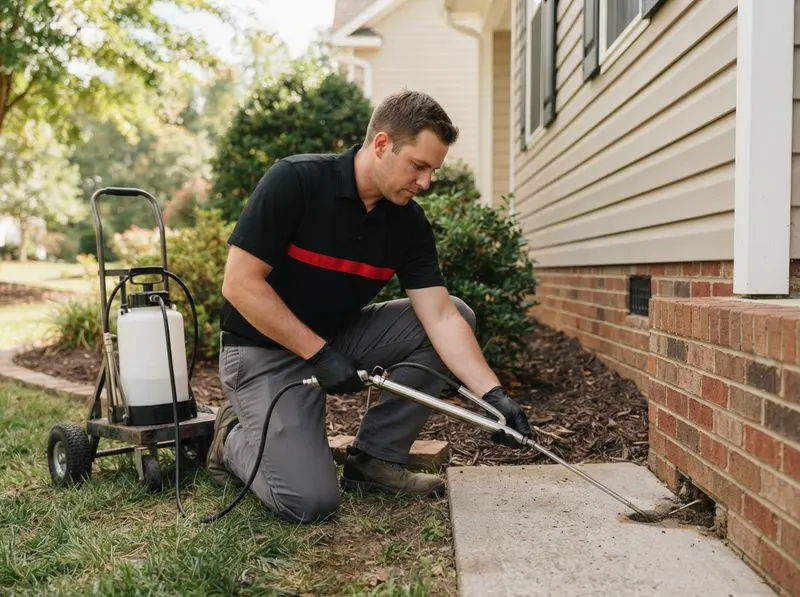
Eastern subterranean termites remain the primary wood-destroying organism in Cary, North Carolina, thriving in the dense pine litter, high soil humidity, and red clay conditions surrounding Bond Park and Hemlock Bluffs. In neighborhoods like Preston, Lochmere, and MacGregor Downs, residential foundation designs often mix crawlspaces with slab-on-grade garages or walk-out basements. Termites access structural framing by constructing mud tubes over masonry foundation walls or through hidden expansion joints behind brick veneer. A professional termite treatment establishes an uninterrupted defensive chemical zone in the soil directly adjacent to these structural contact points.
Treatment approaches divide between non-repellent liquid soil barriers (such as fipronil formulations) and active monitoring bait systems. Liquid trenching applies diluted material into a 6-inch by 6-inch trench around foundation perimeters, binding to clay particles to stop structural entry. The trade-off between the two methods centers on initial disruption versus annual maintenance: liquid soil treatments require shallow soil trenching around exterior landscape beds but deliver multi-year continuous defense, whereas exterior baiting systems eliminate trenching near tree roots but require regular monitoring visits to confirm active bait consumption. In Amberly and Carpenter Village, where newer foundations often feature zero-lot-line proximity or extensive paver patios, localized sub-slab injection drills 0.5-inch holes through masonry slabs to seal voids without broad excavation.
Residential applications are conducted without requiring homeowners to sign multi-year binding contracts unless an ongoing monitoring plan is specifically requested. Treatments prioritize family safety by positioning materials externally in the soil profile or inside enclosed crawlspaces, well away from primary living spaces, kitchen prep counters, and children's play areas. Spot-treating an isolated mud tube on an exterior garage wall without establishing a contiguous foundation barrier leaves adjoining crawlspace joists vulnerable, so on-site linear measurements determine the precise defense boundary before any application begins.
Every job gets a firm, written price after a free on-site visit.
Tell us about your termite treatment service job in Cary and we'll send a clear, written quote, usually the same day.
 Copper Bell Pest Control